Electrodialysis
ION-EXCHANGE MEMBRANE
An ION-EXCHANGE MEMBRANE (IEM) is a membrane that allows certain ions to pass through, but prevents transport of other ions or neutral molecules.
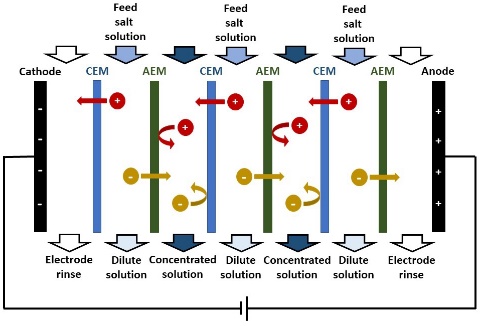
A CATION-EXCHANGE MEMBRANE (CEM) is permeable to cations. CEMs are commonly formed of polymers with negatively charged functional groups.
An ANION-EXCHANGE MEMBRANE (AEM) is permeable to anions. AEMs are commonly formed of polymers with positively charged functional groups.
ELECTRODIALYSIS
In ELECTRODIALYSIS, an applied electric potential difference is used to transport salt ions through ion-exchange membranes from one solution to another. An ELECTRODIALYSIS STACK consists of a series of CEMs and AEMs (separating dilute and concentrated solution streams) between two electrodes.
DESALINATION
Electrodialysis may be used to remove salt from brackish water or seawater, as well as for a variety of other applications. In electrodialysis the ions are removed from the feed water stream, unlike processes such as reverse osmosis (RO) where the water is removed. Electrodialysis is generally more cost-effective for feeds with low salt concentration and RO for feeds with higher salt concentration.
Nanomaterials-assisted on-exchange membranes for electromembrane desalination

