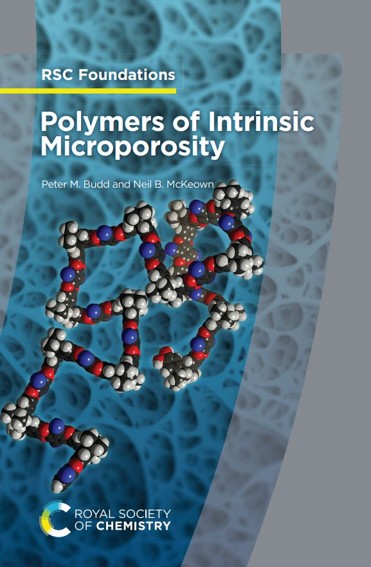
Polymers of Intrinsic Microporosity (PIMs)
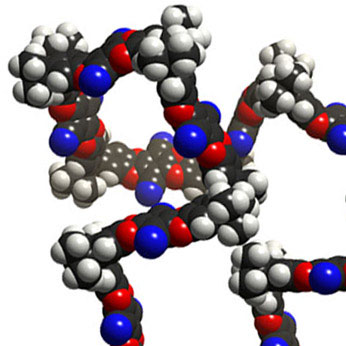
Polymers of intrinsic microporosity (PIMs) are glassy polymers that possess high free volume because their rigid, contorted macromolecular backbones cannot easily pack together to fill space.
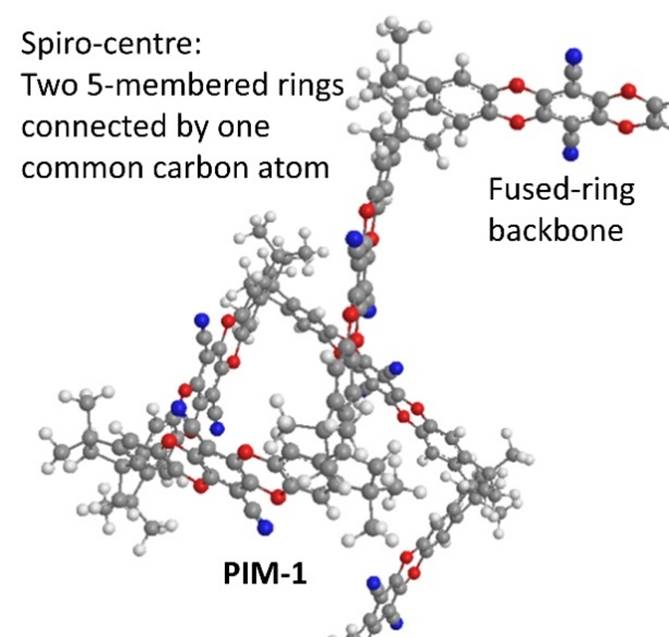
A PIM cannot undergo large-scale changes in conformation because it does not have any single bonds in the backbone about which rotation can easily occur (the backbone typically has a fused-ring or ladder-like structure). However, the backbone twists and turns because it incorporates sites of contortion (e.g., spiro-centres).
MICROPOROSITY
According to an IUPAC definition, a micropore has dimensions <2 nm. Within a micropore, small molecules exhibit enhanced adsorption, due to multiple interactions with pore walls.
INTRINSIC MICROPOROSITY
Intrinsic microporosity refers to a continuous network of interconnected intermolecular voids, which forms as a direct consequence of the shape and rigidity of the component macromolecules.
PIM-1
The prototypical PIM is referred to as PIM-1.
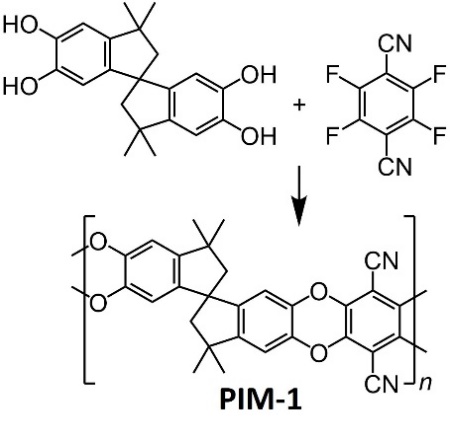
PIM-1 is synthesized by a step-growth polymerization involving nucleophilic aromatic substitution reactions.
PIM-1 is a yellow, fluorescent polymer that exhibits high internal surface area in the solid state. Brunauer-Emmet-Teller (BET) analysis of gas adsorption data typically gives an apparent surface area in the range 600-800 m2 g-1.
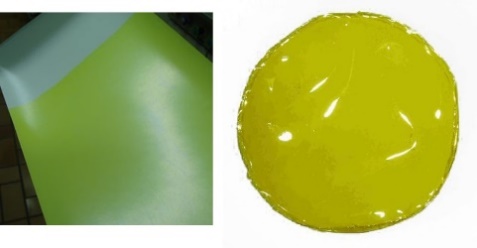
PIM-1 is soluble in solvents such as chloroform and tetrahydrofuran, and can be processed from solution into powders, coatings, films and fibres.
FORTHCOMING BOOK
You will be able to learn more about PIMs in a book to be published by the Royal Society of Chemistry in the RSC Foundations series.