Selectivity and Permeability
For industrial application, a membrane must offer SELECTIVITY, so there is a separation, and PERMEABILITY, so the required membrane area is not too large. There is often a trade-off between these two properties.

FLUX
Flux, J, is the amount of permeate that passes through a certain membrane area in a given time.
It may be expressed in units such as mol m-2 s-1 or kg m-2 h-1.
For a pressure-driven process such as gas separation, the flux depends on the difference in pressure across the membrane.
You may come across unusual units that are used for historical reasons. For example, the amount of a gas is often expressed in units of cm3 [STP], which is the volume (in cm3) that would be occupied by that amount of an ideal gas at standard temperature and pressure (STP). STP is currently defined by IUPAC as 0°C, 1 bar (before 1982 it was 0°C, 1 atm, and this definition is still often used).
PERMEANCE
Permeance is flux divided by pressure difference. Permeance depends on membrane thickness.
Gas permeance is often expressed in gas permeation units (GPU).
1 GPU = 10-6 cm3 [STP] cm-2 s-1 cmHg-1 = 3.348×10⁻¹⁰ mol m-2 s-1 Pa-1
When calculating permeance in GPU the pressure difference is in cmHg (1 bar = 105 Pa = 75 cmHg).
PERMEABILITY
Permeability, P, is permeance multiplied by membrane thickness.
Gas permeability is often expressed in units of barrer.
1 barrer = 10-10 cm3 [STP] cm cm-2 s-1 cmHg-1 = 3.35×10⁻¹⁶ mol m m-2 s-1 Pa-1
If permeance in GPU is multiplied by thickness in µm you get permeability in barrer.
SELECTIVITY
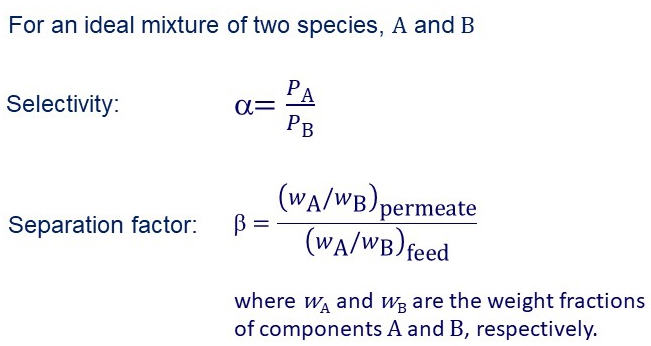
The selectivity of a membrane is often expressed as a ratio of permeabilities.
SEPARATION FACTOR
The ability of a membrane to concentrate up a component of a mixture may be expressed in terms of a separation factor.