Gas Separation
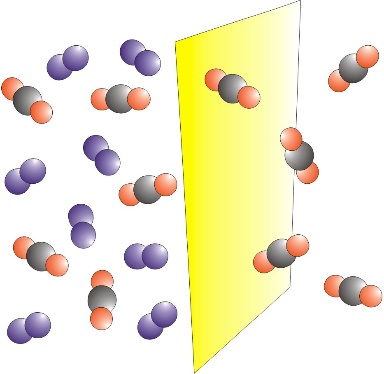
GAS SEPARATION APPLICATIONS
Gas separation membranes are used for applications such as: Air separation for generating nitrogen; Hydrogen recovery in ammonia production; CO2 removal from natural gas.
INERT GAS GENERATION
Many aircraft have an on-board inert gas generating system. A membrane module is used to generate a nitrogen-rich inert gas from air. The inert gas is fed into the fuel tank to prevent ignition of fuel vapours.
MEMBRANE MATERIALS
A membrane material must offer: SELECTIVITY so there is a separation; PERMEABILITY so the required membrane area is not too large; PROCESSABILITY so membranes can be fabricated economically; GOOD MECHANICAL PROPERTIES so the membrane doesn’t fall apart; CHEMICAL AND THERMAL STABILITY so the membrane survives conditions of use; RESISTANCE TO AGEING, PLASTICIZATION AND FOULING so the membrane maintains its performance over time.
ROBESON PLOT
Efforts to increase selectivity often lead to a loss of permeability and vice versa. There is a trade-off between these two properties. For gas separation membranes, the trade-off between selectivity and permeability can be represented on a double logarithmic plot. In 1991 Lloyd Robeson drew the upper bound of performance that could then be achieved with polymer membranes for various gas pairs.
L.M. Robeson, J. Membr. Sci., 1991, 62, 165.
O2/N2 ROBESON PLOT
Conventional membrane polymers, such as the polyimide Matrimid, have low permeability. The substituted polyacetylene poly[1-(trimethylsilyl)-1-propyne] (PTMSP) has very high permeability, but low selectivity. In 2005, two polymers of intrinsic microporosity (PIMs) were shown to surpass the upper bound of performance.
P.M. Budd et al., J. Membr. Sci., 2005, 252, 263.
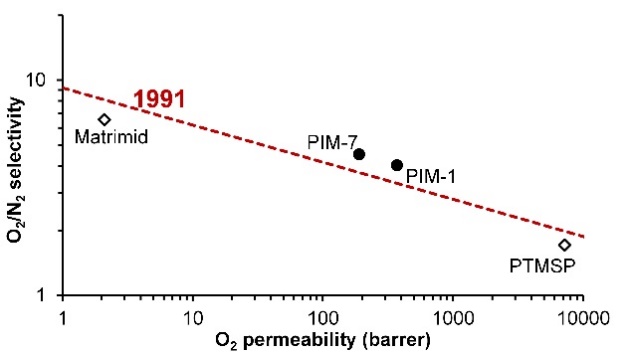
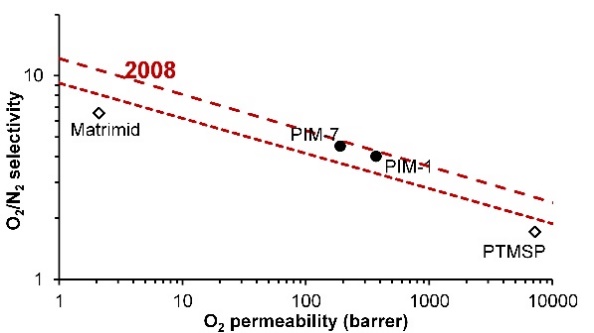
In 2008, Robeson revised the upper bound.
L.M. Robeson, J. Membr. Sci., 2008, 320, 390.
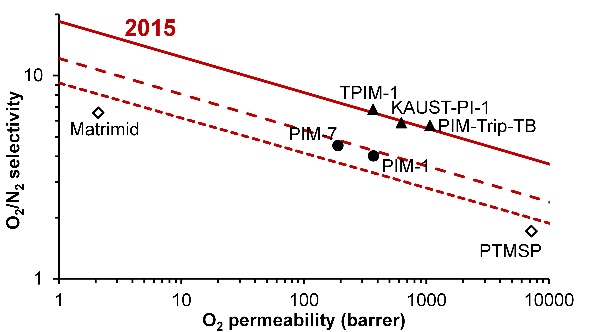
Further developments in PIMs led to a new upper bound being proposed in 2015.
R. Swaidan et al., ACS Macro Lett., 2015, 4, 947.
CO2/CH4 ROBESON PLOT
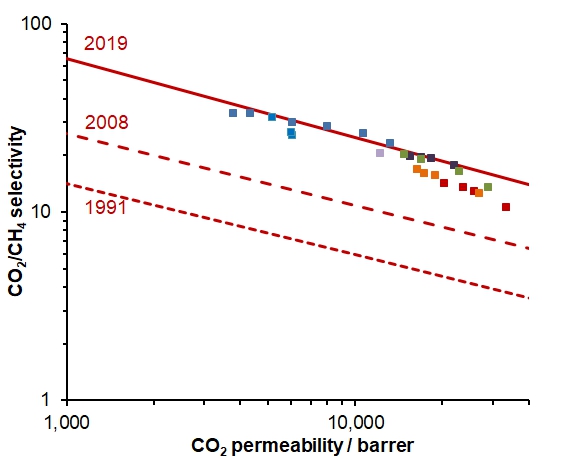
In 2019, new upper bounds were proposed for CO2 separations, based on ageing data for membranes of benzotriptycene-based PIMs.
B. Comesana-Gandara et al., Energy Environm. Sci., 2019, 12, 2733-2740.
GAS PERMEATION
You can find gas permeation data for many membrane materials in a database.
Membrane Database – Polymer Gas Separation Membranes – Virtual Screening of Materials
Machine-learning can be used to predict gas permeability and other polymer properties.
Gas separation membranes are often based on glassy polymers. High free volume, glassy polymers such as PIMs offer the prospect of very permeable membranes, but for commercial application the issue physical ageing, which leads to a loss of permeability over time, needs to be addressed.
Gas permeation properties, physical ageing, and Its mitigation in high free volume glassy polymers
To improve performance, a filler may be added to a polymer, giving a mixed matrix membrane (MMM), or two different polymers may be blended together.
Seeking synergy in membranes: blends and mixtures with polymers of intrinsic microporosity

